
 Contexts, from yesterday to today
To avoid repeating ourselves (too much), we would prefer to refer curious readers to the two previous reviews (in French), of performances of this symphony by Kirill Petrenko in Bregenz (‘Et l’Esprit descendit) and Munich (‘Hymne à l’amour’), which will complement the present analysis.
The Eighth Symphony, by its monumentality and nature, raises many questions that allow it to be considered from many different points of view. Such an interpretation also forces the listener to delve into themselves, to delve into their own history, in order to draw out a kind of ‘new’ substance, which does not consist solely of repeating ad infinitum the incredible interpretative, artistic and technical mastery of what we have heard.
I prefer to consider the context of listening and, to quote Victor Hugo, ‘What the mouth of shadow says’ (“Ce que dit la bouche d’ombre”), that is to say, the various emotions that arise when listening to such a monumental work.
The Eighth Symphony was composed by Mahler mainly in 1906 and completed in the early months of 1907, but performed in 1910. This symphony, with its seemingly open and optimistic accents, is dedicated to the power of the Spirit, but these luminous accents were quickly overshadowed in July 1907 by the sudden and unexpected death of his daughter Maria-Anna, by the first warnings of his heart disease, and then by his resignation from the Vienna Opera, after a fierce press campaign typical of Vienna, which he left in October after conducting Fidelio.
This luminous moment that characterises the Eighth, sandwiched between more tense, more tragic symphonies (the Sixth, Seventh and Ninth), is therefore a kind of hapax, a surge of faith in the Spirit, in man, in humanity in the midst of difficult years. And indeed, the premiere in Munich in September 1910, a triumph conducted by Mahler himself and receiving an ovation lasting more than thirty minutes, was the last of his works that he premiered and heard, since Das Lied von der Erde, composed in 1907, was premiered after his death in 1911 by Bruno Walter, who also premiered the Ninth in 1912.
The last work premiered during his lifetime, an indescribable triumph, this symphony carries within it the paradox of being a song of elevation and optimism, but Mahler, conducting it in 1910, knew he was ill, weakened and had been terribly affected by life : a conductor as wise and sensitive as he undoubtedly took this into account in his interpretation. Once again, the tragedy of life had struck.
Kirill Petrenko, so keen to understand the conditions under which the works he conducts were created, the notes of contemporaries, critics, writers, but also musicians, is too astute not to take into account the fact that this symphony was written by Mahler during a period of respite and premiered at a more tragic time, a few months before his death on 18 May 1911.
This is not a paradoxical injunction, but rather a matter of modulating an interpretation according to context.
And to the context of its creation must be added the context of this Berlin performance, in the midst of a world in turmoil and upheaval, where the Spirit seems to be the last thing on anyone's mind.
This is undoubtedly why this performance struck us as both grandiose, open to hope through its breath, but also to doubt through the tension it diffused.
The intellectual substrate
One of the most frequent discussions about this symphony is the apparent inconsistency between the first and second parts.
The first part, the Veni, creator Spiritus, a Pentecost hymn written in the 9th century, is attributed to Raban Maur (Hrabanus Maurus), although this is disputed, as there are several saints in the running, including Saint Ambrose of Milan (397) and Saint Gregory the Great (604), and even Charlemagne in 814. But no matter, it is a great religious song of reference, imploring the Holy Spirit to shower humans with his gifts. It is, of course, a song in Latin.
The second part is the final scene of Goethe's second Faust, and is therefore in German. It constitutes the purifying vision of Faust's soul (Doctor Marianus, Faust saved from Hell) rising to Heaven, accompanied by Angels and singing of love and the ‘eternal feminine’, seen as the soul of Marguerite who saved him. Even though Goethe deliberately uses Christian vocabulary, it is a whole mythology that is invoked, even the mysteries of Isis (‘Mater Gloriosa’ as mother goddess), which it is not our place to unravel here.
Goethe's text is so rich, so unexpected, so diverse in its brilliant disorder, drawing on the multiple sources of knowledge and spirituality of European culture. It is a text imbued with the optimism of universal knowledge that permeated not only the Enlightenment, but also the scholars and philosophers of the Renaissance, steeped in Neoplatonism, a Neoplatonism that is not so far removed from the cult of the Spirit as the supreme good that one senses when reading Faust, and especially its final scene.

An iconic masterpiece of this spiritual optimism has always fascinated me : Raphael's The School of Athens, in the Pope's apartments in the Vatican (the "stanze di Raffaello” ). The Middle Ages were steeped in Aristotelianism, and the Neoplatonic vogue meant that the painting was constructed around the figures of Plato, holding the Timaeus, and Aristotle, holding the Ethics. The entire painting is a depiction of a happy and colourful universe, rich in intellectual activity, made up of thinkers and artists, of everything that the human spirit has been able to generate and produce. The fact that this work is at the heart of Christian power also speaks volumes about the relationship between Christianity and antiquity.
Did Nietzsche not say that Christianity was ‘Platonism for the people’?
"The fight against Plato, or to put it more intelligibly and for the “people”, the struggle against the millennial oppression of the Christian Church—for Christianity is Platonism for the people—has created in Europe a sumptuous tension of the spirit, such as has never before existed on earth : with such a taut bow, we can now aim at the most distant goals"[1].
But at the same time, Raphael represents the first artist to be considered a “creator”, a bearer of Spirit, that is to say, a bearer of the “divine” insofar as, faced with the sole creator who was God, the artist became, in a way, the bearer of another value that transcended both his being and his work.
We must consider all this background, the history of our thought, our humanity, our culture, when we think of Goethe's Faust, one of the major works of European literature, along with Dante's Divina Commedia, Shakespeare's Hamlet, Cervantes' Don Quixote and Hugo's Les Misérables.
There is something of a resultant in the teeming syncretism of Goethe's Faust, and the fact that Goethe's text has been set to music or translated into music so many times is also an indication of this, because music is also the art of paradise (see the angel musicians in Giovanni Bellini's paintings, for example).
There is therefore something profoundly intellectual and at the same time profoundly sensualist, in the sense of Condillac, in Mahler's undertaking of the Eighth, which makes it a strange and fascinating object, like a way of reactivating, in the manner of Nietzsche, the emotional dimensions of Culture and its universal power.
The aim is therefore to show what unites the two seemingly distant parts : what do a 9th-century Latin text referring to Catholic liturgy and the hymn to totality in the spirit of the Enlightenment that floods the final scene of Faust, concluding a second part that is a journey through the space and time of the universe, history and its myths, since Helen of Troy, have in common ?
Mahler was fascinated by Goethe's text, like all 19th-century intellectuals, whom he considered to be a poet, a ‘literary figure’, but also a thinker.
It is difficult for someone who is not from a Germanic culture to imagine the power of Goethe's text and, in particular, how overwhelming it can be in its variety, its wordplay, its echo systems, its cultural references, and its sensory and sonic depth.
In 2000, in Hanover, I had the immense privilege of attending a performance of Goethe's complete Faust (Faust I and II) directed by Peter Stein, which French-German tv-channel Arte broadcast at the time and of which a video exists.
The performance lasted approximately 24 hours, with interruptions of varying lengths, in the modular space of a large hangar at the Hanover World Expo (Expo 2000). The position of the audience varied : either facing the stage, separated by a central stage, in the centre while the actors performed around them, or mingling with the actors during other scenes.
It was a fundamental experience in approaching what Goethe could represent and, by deduction, in understanding what he could represent for the young Gustav Mahler, who never ceased to have him at his bedside.
Beyond the play, beyond the experience of being a spectator, beyond the staging, it was the experience of the language, its evocative power, its words, its sounds that remained for me something totally overwhelming and unique. I would never have believed that a language I knew, but which was still foreign to me, could have such a physical, aesthetic, emotional and almost sensual influence on me. Until then, I had found Goethe's poetic texts sometimes a little grandiloquent, but this time I experienced their power, their grandeur and, it can be said, I understood what Goethe's genius was.
And this Goethean experience, this physical and aesthetic experience, is for me at the heart of the experience of Mahler's Eighth.
What makes this symphony unique is the constant interweaving of words and musical notes, words spoken by soloists and hundreds of choristers of all ages, men, women and children, that is to say, the world.
Mahler's Eighth brings this experience of totality to life and, for me, revives it insofar as I had already experienced it in a way by immersing myself for 24 hours in Goethe's 17,000-odd verses, and Mahler undoubtedly wanted to honour this power through his work.
People will continue to argue that the first part has nothing to do with Goethe. This is true formally, but false in substance. Around 1820, Goethe came across the text of Veni, creator spiritus and translated it into German. He said of it, "The magnificent church song Veni creator spiritus is a call to genius. It therefore has a powerful effect on strong and elevated souls.‘’
In a way, he turned a ninth-century religious text into a Goethean text about the Spirit, the Spirit that pervades his Faust. Opinions differ as to whether Mahler was aware of this translation.
If so, the linking of the two texts makes the entire symphony a Goethean work and therefore totally coherent, in its ‘Spirit’ and (almost) in its letter. If, on the contrary, he was not aware of it, it is proof of the artist's intuition, but ultimately the result is the same : what makes this symphony coherent is the Enlightenment glorification of the human spirit, the glorification of the strength of humanity in its variety and diversity, a humanity of which the combined forces of this symphony are a metaphor.
For we find in it all the human voices on the one hand and, on the other, the entire human instrumentarium, that is to say, its technical strength, its way of creating tools, those ‘tools for making music’ that are instruments. Let us not forget that at the time of its creation, there were almost every instrument imaginable, 171 different ones in fact… The musical instrument thus becomes a product of human craftsmanship and a metaphor for the technological production of the human mind, with the musician becoming the craftsman playing with his tool and all the voices, singing together or individually : the Eighth is therefore a manifestation of all human activity in a sense that Diderot and d'Alembert's Encyclopédie would not have contradicted. Thus, Gustav Mahler's Eighth Symphony is perhaps the last authentically Enlightenment undertaking, because it is first and foremost Goethean.
It is the musical experience of the universal. It is the staging of the universal, and we know that Gustav Mahler was very interested in the then-new art of staging.
We can finally understand the meaning that this performance can have today in a context ravaged by the absurd, the grotesque and a certain monstrosity or animality. This symphony stands like a mountain of humanity against everything that surrounds us and that we look at in amazement and disbelief…
By chance, these two concerts were performed at a time when the Iranian people were rising up and being massacred by their government (in the name of God, of course), and at the very moment when Trumpzilla wanted to invade Greenland. In Berlin, so ravaged by history, there was a kind of tiny island that exuded a mystical happiness, but at the same time was an immense symbol : art is resistance, art is refuge, art is human.
The musical performance
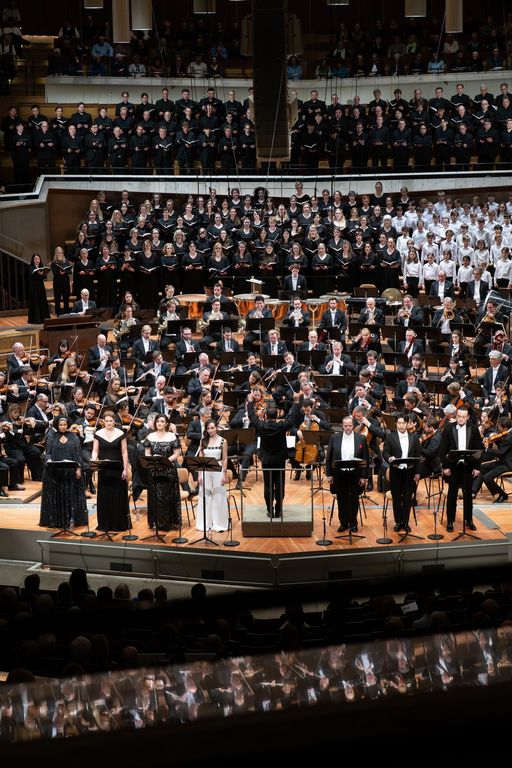
It is clear that in such a context, the musical performance acquires an emotional power that goes far beyond a concert evening, in a legendary hall that amplifies all the effects of the music, through its acoustics, through its very special space, which is itself like a kind of giant cell whose nucleus is the orchestral podium, surrounded by so many units made up of clusters of people gathered in "blocks " with an invisible circulation of sound.
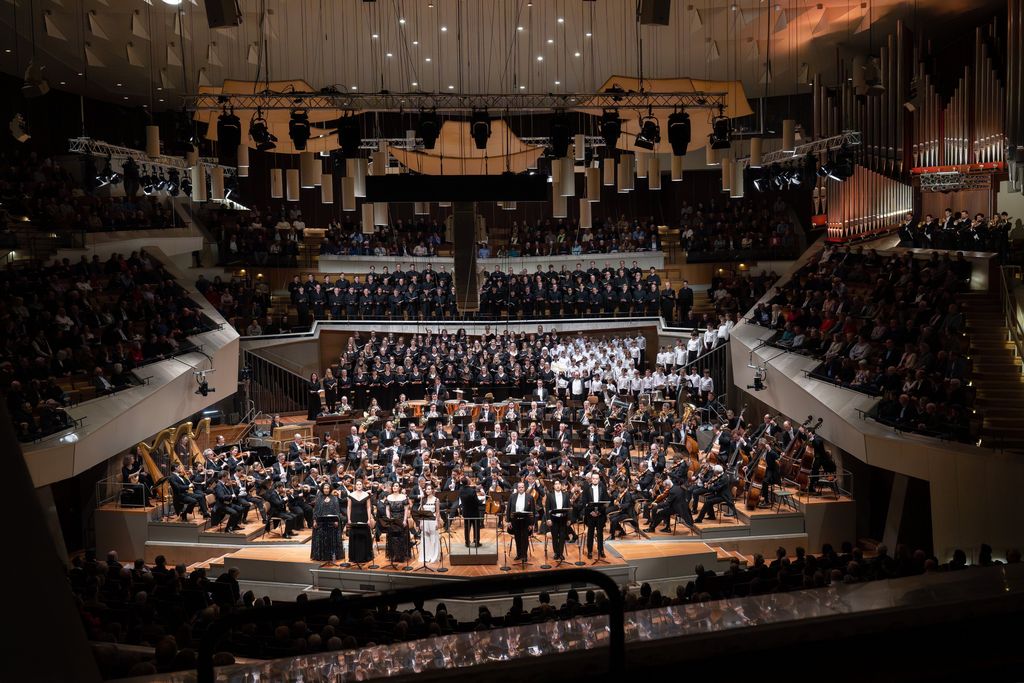
The central space is occupied by the enormous orchestra, part of the three choirs on the rear podium, the children's choir on the side stairs, and an almost entire block (the central Block H) is occupied by the choir, with a few spectators remaining on the sides, next to the choristers. Above, the organ, from which the triumphant brass of the finale of the first and second parts will emerge, and from which Jasmin Delfs will sing ‘Mater gloriosa’ as a soloist.
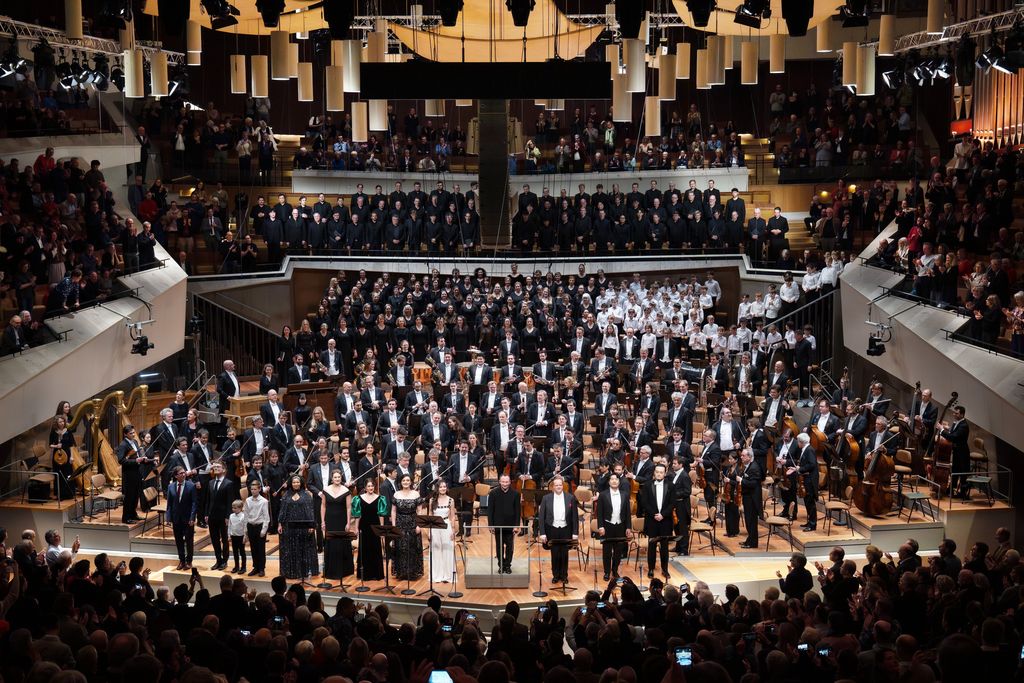
As the solo voices are essential, they are in the front row in front of the orchestra, because this is neither an oratorio nor a symphony with choirs, but a ‘choral-vocal-symphony’ as a whole, as emphasised above, where everyone is part of an ensemble, from the soloist to the last of the choristers, but also the conductor. In this case, Kirill Petrenko, particularly on the second evening, vigorously refused to allow the ovation to turn into adoration of the conductor-god, but always ensured that he remained at the heart of the collective.
The dominant impression, as always, is Kirill Petrenko's incredible control over the ensemble's volume. This is clear from the opening chord in E flat major (that of The Magic Flute…), which we expect to be explosive, but which imposes itself without any fuss or spectacular exaggeration.
In a work where it is so easy to overwhelm the listener with sound and where it is so easy to impress, Petrenko chooses to work from the whole to the particular, like a kaleidoscope, and above all to maintain a sustained dynamic with a lively tempo, without complacency, without lingering : he allows us to consider the whole and at the same time a whole series of details, even the smallest ones. We recognise one of the principal qualities of his interpretations, which is clarity, that is, the way in which each instrument in the orchestra stands out, makes itself heard and, above all, modulates itself according to the demands of the moment, even when the voices dominate : nothing escapes the ear, as is the case with the solo violin's intervention in the middle of the first part, with the soloists and the choir, Daishin Kashimoto's timid little voice is incredibly soft and clear. Similarly, a little later, the intervention of the bells, followed by a series of solo instruments at a very sustained rhythm, with various interventions, including pizzicatos, then a slowing down and expansion to the soloists and choir, illustrating a surprising dialectic of tension and breathing.
There are moments in this score that are obviously particularly impressive as a whole, never overwhelming, but so airy that they seem to lift us up. There are also intimate moments where the sound is very thin, moments where only the solo voice dominates and, very often, and this is a specific characteristic of this work, the orchestra, the sound of the orchestra seems to disappear behind the vocal volumes.
But this is entirely the effect of Petrenko's work : nothing is inaudible and everything is always present in a kind of ‘Greek’ economy of ‘μηδὲν ἂγαν’ (mêden agan), ‘nothing in excess’, inscribed on the pediment of the Temple of Apollo at Delphi, Apollo, the god of music and song, but also of rigorous thought according to Nietzsche (him again…). Indeed, nowhere is there anything superfluous, nowhere is anything overplayed or over-sung. Everything is woven into a continuous discourse of rare fluidity, in which the different moments and voices flow smoothly from one to the next, helping to magnetise, enthral and captivate the listener.
As always, the gestures are precise ; I have often amusedly compared Petrenko to a kind of Shiva goddess of conducting, as nothing escapes him, his arm, his gaze and his body are so expressive and legible that one has the impression of understanding at a glance where each soloist, each choir or each instrumentalist should intervene. He leans towards the soloists to coach them on the text, but also to indicate the rhythms and modulations, which, combined with the clarity that is the central element, gives the impression of a multicoloured painting with sharp colours and clearly identified shades, where everyone is in their place, everyone is heard, and where the listener who wants to focus on a particular aspect can do so and then discover other depths.
It is obviously at the beginning of the second part, when the orchestra is left alone, that the solo instruments take flight, each intervening in an extremely restrained, precise, but also very melancholic manner, leaving a mysterious and almost nocturnal atmosphere, an atmosphere of waiting, an almost suspended atmosphere that deeply embraces the listener.
What characterised the audience at both concerts was its extreme concentration, a concentration that is not new : Abbado himself said that the Berlin audience was one of the most receptive and focused there is, and this ability to listen, this way of turning inward, was heard here between the two parts, with this long silence, this long moment of waiting where the audience obviously did not applaud, but did not even cough either, even though the virus-ridden period might have led one to expect it. But no, there was something in the hall that in a way transcended us, captivated us.
The result is a special atmosphere that is both focused and a little tense, because the nature of this interpretation is also to never indulge in blissful optimism, in a kind of exclusive outpouring of the heart and sensitivity.
That's not what it's about. Once again, it's about saying two things that are opposed and united, two contradictory certainties in terms of what is said and what is felt.
On the one hand, there is an undeniably open and optimistic vision, both in terms of the composer's worldview and his individual disposition. At that time, he was trying with all his might to win back his young wife Alma, to whom he dedicated the work, and we can imagine that ‘the eternal feminine’ (Das Ewig-Weibliche/Zieht uns hinan) (‘The eternal feminine draws us upwards’) referred to in the last words of the work may refer to Alma, to whom Mahler offered this monumental symphony as a kind of proof of love, of a mystical love and a supreme gift of self. But it is also a deeply human love, keenly felt at a time when the young woman is already looking elsewhere : this is what I have called in another text "a hymn to love”. Of course, Petrenko does not forget the personal component or the exaltation of certain intimate moments, through certain silences, through certain moments when the sound fades to the ineffable or inaudible, and through certain sensitive exaltations in the interventions of the choirs with whom Petrenko often sings.
There is indeed an enormous personal commitment on the part of the conductor in this direction, communicating a vision that is both human and global, the human being in his own right and among others, but also and always something of the human tragedy. Petrenko's Mahler is always tragic in a way.
Behind all the breathing space, behind this openness to the cosmos, an almost welcoming cosmos, behind this final redemption, behind this breath of the Spirit on both parts of the work, there is also a subtextual certainty that perhaps everything is over.
I mentioned above the premiere in 1910, a few months before the composer's death, at a time when he had been through illness, failure, the death of his daughter, and a time when, in a way, there was less room for hope, openness and the triumph of the human spirit. When he composed it in 1906, he was filled with optimism, boundless love for Alma and faith in her return, faith in the future.
 Three and a half years later, at the premiere, this was no longer the case. Petrenko conveys this by never letting up, always maintaining an underlying tension, suggesting that behind the breaths there is drama, perhaps even the end, suggesting that all the confidence in the future that had permeated the composition is now gone.
Those happy days are no more.
And the work becomes, in a way, like a sublime Recherche du temps perdu (“In Search of Lost Time”). This is also what gives this interpretation its profoundly human quality, alternating between moments of confidence and moments where we feel the heart and its irregularities, but inevitably at other moments, we are overcome by this or that intervention flooded with melancholy or sadness : this is the effect produced by the very beginning of the second part, where each instrument sings both mystery and a certain nostalgia… Kirill Petrenko gives us a completely dialectical interpretation, offering no synthesis : there is joy and there is the end, together there is faith and there is the certainty of nothingness, which makes this moment utterly overwhelming.
Once again, Petrenko gives us a reading that is deeply in tune with the moment we are living in, a moment when art retains its function as humanity's last beacon. And at the same time, we watch humanity fall into the abyss and risk losing itself…
Mahler considers his love for Alma and wants to win her back, but perhaps he does so with the energy of despair of someone who knows that everything is already destroyed and that beyond the hymn to love that is this symphony, to human love, to the love of humanity, to the love of the spirit, perhaps everything is already over.
Perhaps we are already crushed, perhaps the barbarians are already among us, and so perhaps all that remains is the glimmer offered by the performance of the symphony, which is itself ‘illumination’ almost in the Rimbaudian sense of the term, an immense poetic and desperate affirmation.
It reminds me of what pianist András Schiff said in an interview, essentially that ‘the barbarians destroyed Rome, but 800 years later Giotto arrived’. Awareness of destruction, joy of possibilities, faith in a future for the human Spirit in its greatest achievements, even as we stand on the brink of the abyss.
We listen to this symphony, permeated by moments of joy and love, but also of doubt, fear and tension : in a way, Petrenko has struck us right in the heart.
That is basically why I chose as the title of this review ‘for the love of humanity’, a quote that concludes the Scene of the Poor Man in Molière's Don Juan, where we cannot tell whether Don Juan is sincere or sarcastic when he invokes this love of humanity.
The love of humanity in this symphony is blinding, and at the same time it is perhaps already crushed by the prevailing barbarism. Ambiguity…
Petrenko tells us in this interpretation, "let us still love, but it is over… "
Contributing to this interpretation were, among others, the usual soloists, the amazing Berliner Philharmoniker, Chinese horn player Yun Zeng, Wenzel Fuchs on clarinet, Marie-Pierre Langlamet leading the three harps, new principal flutist Stefan Ragnar Höskuldsson, Albrecht Mayer on oboe, Ludwig Quandt and Bruno Delepelaire on solo cellos, Daniele Damiano on bassoon and, of course, Daishin Kashimoto, the first solo violinist already mentioned. The orchestra continues to renew itself, but it always remains the same, like a kind of immutable troupe, as if eternity itself were changing it.
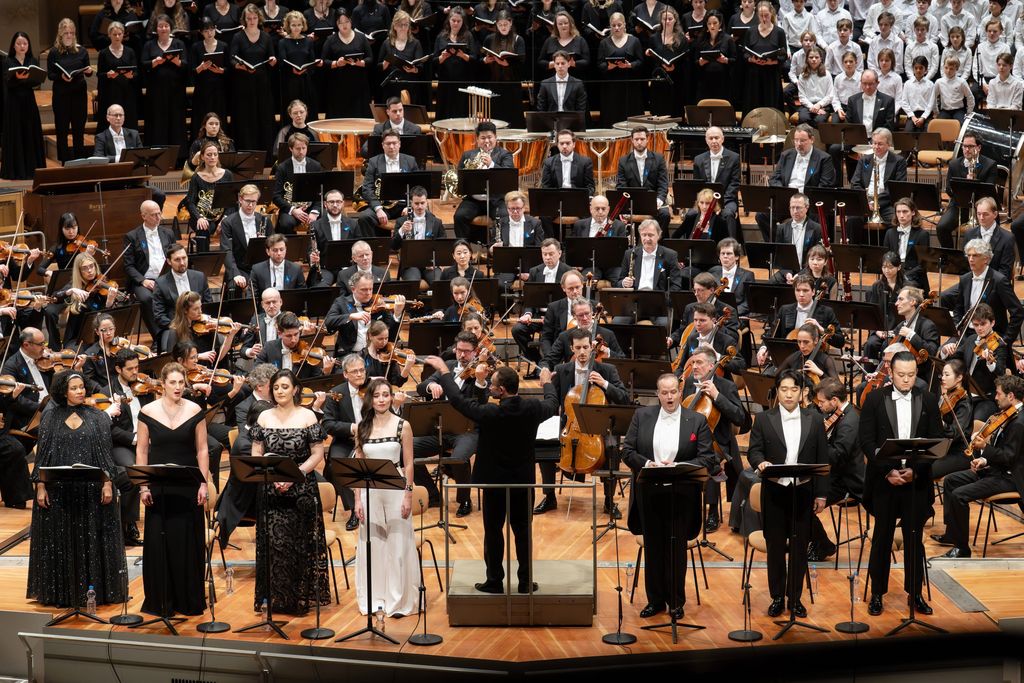
From the soloists' point of view. It should be noted that, whether short or long, the performances are particularly difficult and that the voices in the Philharmonic do not sound the same depending on where you are sitting, but the feeling of universality is conveyed first and foremost by these soloists, who come from all corners of the globe (Europe, Asia, America, Africa), illustrating a humanity united in its diversity in Mahler and Goethe. Cultural universals remain, far from being all European, fortunately.
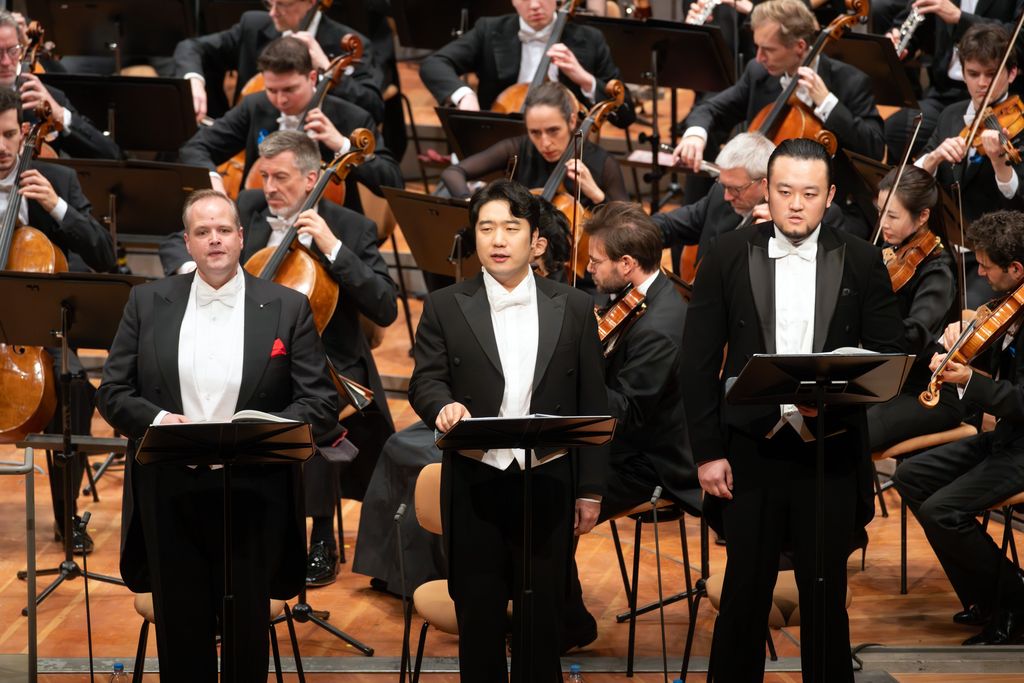
Benjamin Bruns' Doctor Marianus (Faust in redemption) with his clear, powerful voice, perfect delivery and impeccable diction, which makes every word understandable, and his renewed power, makes him the great triumph of the evening, as he was in Munich. Immense, quite simply. Here is a first-rate tenor who is quietly becoming the leading tenor of today.
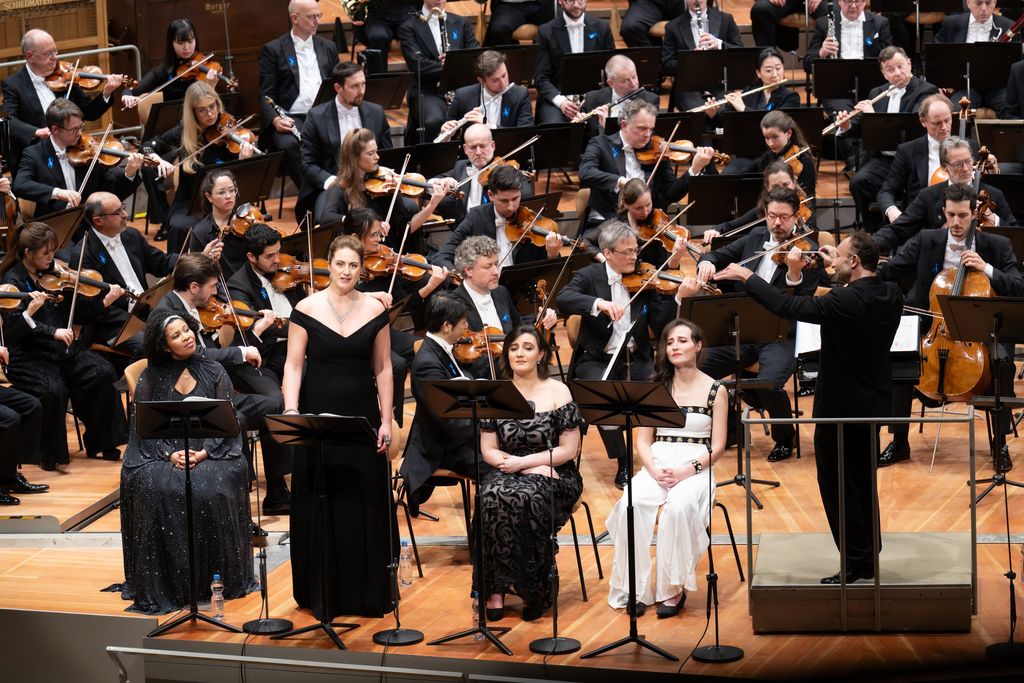
Golda Schultz (Una Poenitentium) was also impressive, with a clear, fresh, luminous voice, beautiful breath control and a rich tone that made her performance very moving. The same can be said of the highly controlled and technically perfect Jacquelyn Wagner (Magna Peccatrix), with her remarkable volume and infinite breath, but perhaps a touch less moving. The contralto voice of Beth Taylor (Mulier Samaritana) was very impressive, demonstrating such breadth, volume, consistency and control across the entire spectrum that we are undoubtedly hearing one of the greats of the future.
Fleur Barron (Maria Aegyptiaca), on the other hand, was perhaps less effective in the vast nave of the Philharmonie ; although she is accurate and moving, she remains somewhat in the background.
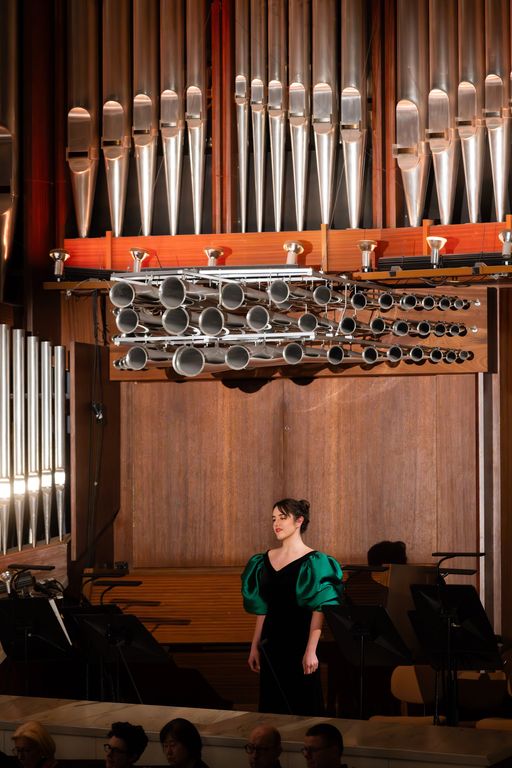
Finally, Jasmin Delfs, from the top of the organ podium, seemed less at ease than she was in Munich or in the royal box, where she had greatly impressed us in Mater gloriosa. Here, the voices blend together a little and perhaps fail to captivate us as they did before. Perhaps this is a temporary difficulty, or perhaps it is also the acoustics, which are not favourable to her.
The young Korean baritone Gihoon Kim (Peter Ecstaticus) is particularly interesting, both for the way he chisels out each word, which is essential in this work for reasons we have already explained at length, but also for his velvety timbre, well-controlled volume and fine technique : he is a singer to watch.
On the other hand, Le Bu's bass voice (Pater Profundus) does not make us forget Georg Zeppenfeld in Munich ; his performance is very correct but a little impersonal…
At the end, the audience, which had been focused until then, erupted into an immediate, general and insistent standing ovation on both evenings. On the first evening, Petrenko appeared delighted, even going so far as to blow a kiss to the audience, and the next day he was just as happy but more reserved and more eager to blend in with the group. Indeed, he gave us, they all gave us, an immense gift of humanity, a ‘puddle of eternity’ in the words of Rimbaud and Abbade. I, who had long remained somewhat distant from this work, was completely captivated and utterly moved…
Final words, a few lines from Goethe that conclude the work.
Doctor Marianus
auf dem Angesicht anbetend.
Blicket auf zum Retterblick,
Alle reuig Zarten,
Euch zu seligem Geschick
Dankend umzuarten.
Werde jeder bess’re Sinn
Dir zum Dienst erbötig ;
Jungfrau, Mutter, Königin,
Göttin, bleibe gnädig !
Chorus Mysticus
Alles Vergängliche
Ist nur ein Gleichnis ;
Das Unzulängliche,
Hier wird’s Ereignis ;
Das Unbeschreibliche,
Hier ist’s getan ;
The eternal feminine
Draws us upward
Doctor Marianus and Choir
Look up to the gaze of the Saviour,
All tender and repentant,
To be transformed in divine happiness
With grateful hearts !
May every good thought
Be offered in your service ;
Virgin, mother, queen,
Goddess, grant your grace !
Mystical choir
All that is ephemeral
Is but allegory ;
The insufficient
Becomes here an event ;
The indescribable
Is here realised ;
The eternal feminine
Draws us towards the heavens.

