Rosy-fingred Dawn appeared once more,
and Ulysses recognised his land.
Daylight rose over the hills,
and his heart was lifted with it.
Alessandra Ferri’s recruitment coup
When the Vienna State Ballet unveiled its 2025–26 season last April, ballet watchers found themselves almost more absorbed by the list of dancers than by the programme itself. Ferri used the moment to reveal the scale of her overhaul, having recruited aggressively to reshape the upper ranks of the Company. Hamburg (home to the outstanding Alessandro Frola, one of the defining figures of the late Neumeier era), New York (Cassandra Trenary), Amsterdam (Victor Caixeta), Stockholm (Kentaro Mitsumori), Tbilisi (Laura Fernandez Gromova), Lausanne (Alessandro Cavallo) and Bratislava (Vladislav Bosenko) all lost key artists. Munich, however, suffered the most conspicuous blow : the departure of António Casalinho, the ballet world’s wunderkind, who joined the Bavarian State Ballet after winning the Prix de Lausanne and was promoted to Principal in November 2024—at just twenty-one—alongside his partner in life and frequently on stage, Margarita Fernandes. Madison Young, widely regarded as one of Munich’s strongest Principals, also returned to Vienna, where she had previously danced under Manuel Legris.
Some pillars of the Viennese company remain—Olga Esina and Davide Dato among them—but the newly reconfigured line-up is undeniably enticing. After a revival of the rather lacklustre local Giselle, Ferri chose to bring into the repertoire a large-scale narrative ballet created in March 2020, on the eve of the pandemic, by Alexei Ratmansky for American Ballet Theatre. A European premiere, a profusion of leading roles and a recent worldwide broadcast made Kallirhoe the perfect vehicle through which to showcase the Company’s renewed forces.
The Young and the Restless from Syracuse to Mesopotamia
Ratmansky and his dramaturg Guillaume Gallienne drew their material from The Adventures of Chaereas and Callirhoe, an ancient Greek romance by Chariton of Aphrodisias and, according to scholars, the earliest novel to survive in its entirety. The plot is extravagantly baroque. Callirhoe, a woman of superhuman beauty and the daughter of Syracuse, falls passionately in love with Chaereas, a young hero as athletic as he is impulsive. They marry, despite paternal opposition. Rejected suitors plot to inflame Chaereas’s jealousy ; deceived, he strikes Callirhoe in a fit of rage. She collapses, is presumed dead, buried in a lavish tomb, then awakens just in time to be abducted by pirates and sold into slavery in Miletus. What follows is a headlong succession of forced marriages, court intrigues in Babylon, war between Persians and Egyptians and a concealed pregnancy. Callirhoe moves from the arms of Dionysius, a noble widower consumed by love, to those of Mithridates, an ambitious satrap. Chaereas, devoured by remorse, sets out in search of her, is captured, enslaved and ultimately transformed into an improbable war hero. The story unfolds like an ancient soap opera, piling improbability upon improbability until the final reunion, where love—tempered by suffering—prevails in a gesture of magnanimous forgiveness, child included.
Ratmansky makes no attempt to tame this narrative excess. On the contrary, he embraces it, occasionally taking mischievous pleasure in disorienting the viewer. At moments, one might wonder whether a scene has been missed ; in fact, the plot simply moves at relentless speed. Kallirhoe does not tell a story so much as accumulate them. Where another choreographer might have pared down, Ratmansky layers. Where abstraction might have suggested itself, he insists on storytelling, chaining episodes together with uncompromising momentum. The choreography never dilutes the drama ; it amplifies it, sometimes to the point of saturation, asking considerable attention and stamina of its audience.
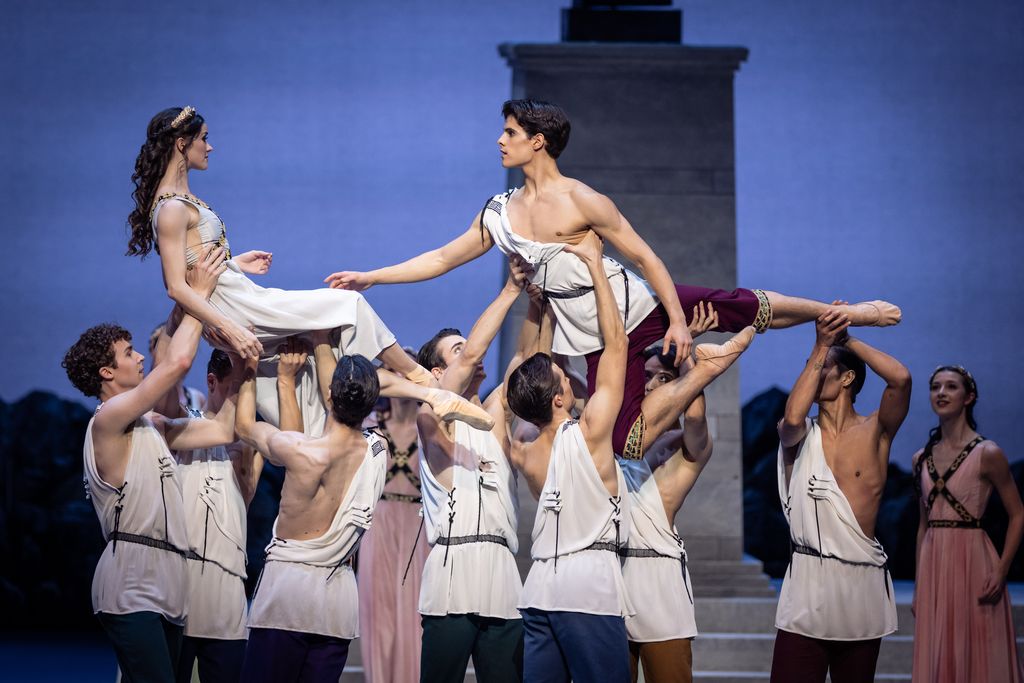
The stylistic contrast between the two acts is striking. The first unfolds with narrative clarity and a certain visual subtlety ; the second is more abrupt, openly invoking the grand Soviet ballets in the mould of Spartacus. Several scenes—most notably the breath-taking martial confrontation between Chaereas and Dionysius and their respective troops—border on quotation. Some may perceive imbalance here. Yet both acts share the same impulse to translate narrative abundance into stage imagery. Ratmansky, who once worked at the Bolshoi reviving The Bright Stream, The Bolt and Flames of Paris, has an abiding fascination with the collective : crowds, courts, armies, communities that observe, judge and condemn. Even in the more academic idiom of his Coppélia for La Scala, this preoccupation with the ensemble—sometimes unwieldy—was already evident. In Kallirhoe, intimacy is rarely private. Except for a handful of pas de deux, even the most personal moments unfold within a living, watchful group. Individuals and couples are caught in a web of opposing forces and gazes, lending the ballet an almost political density : private drama is perpetually exposed to public scrutiny, both on stage and in the auditorium. Ratmansky calibrates adagios, narrative clarity and flashes of collective or individual virtuosity with consummate skill.
The musical dimension matches this sense of excess. Aram Khachaturian dominates the score, arranged by Philip Feeney, largely drawing on Gayaneh. Introspective passages—at times recalling piano concertos—alternate with thunderous outbursts of snarling brass and tribal percussion, saturated with martial rhythms and orientalising colour that unmistakably evoke the dramballet tradition mirrored on stage. From these contrasts Ratmansky draws a hallmark musicality : keenly responsive, occasionally askew, and acutely sensitive to rupture. A suspended pas de deux may be violently cut short ; a moment of tenderness can erupt into fury. Nothing settles for long. The choreography mirrors the emotional volatility of the narrative, in close dialogue with the score. Paul Connelly, former music director of American Ballet Theatre and a close collaborator of Ratmansky, leads the Vienna State Opera Orchestra with authority and flair, shaping a performance of great precision and breadth—from near-overwhelming power to the most delicate caress.
Wiener Staatsballett triumphans
The sheer energy radiating from both performances leaves little doubt that a collective transformation is underway at the Wiener Staatsballett after the lethargy that followed Manuel Legris’s departure. Both casts perform with palpable enjoyment, often dazzling, and are rewarded with fervent ovations on each evening. The opportunity to work with Ratmansky, combined with the abundance of significant roles, has clearly galvanised the troupe, and the audience, in turn, benefits from two sharply contrasted interpretations.
The corps de ballet, omnipresent throughout the evening, gives substance to every scene, creating vibrant, animated tableaux even around moments of intimacy. The women form a compact, expressive tragic chorus, amplifying Callirhoe’s fate ; the men, especially in their warrior formations, project formidable martial resolve. Technical consistency across the Company remains one of Ferri’s challenges. On both nights, the corps de ballet showed similar lapses in alignment and basic port de bras. Kallirhoe is not Swan Lake, and Jean-Marc Puissant’s generous costumes are forgiving, but the ensembles—particularly the women—were not always razor-sharp, despite the undeniable commitment and joy of the performers.
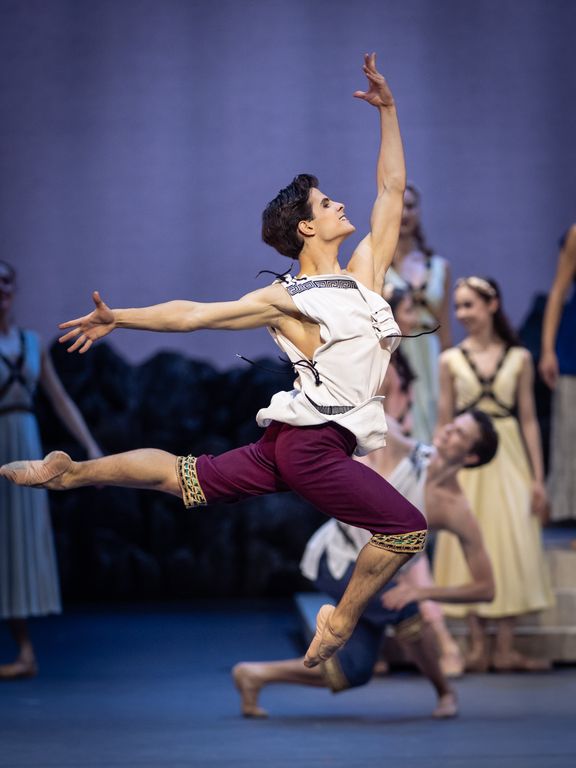
Callirhoe herself emerges as a modern tragic figure : subjected to divine caprice and male violence, yet never broken. Her lyrical solos radiate an almost supernatural inner strength, while the lifts emphasise vulnerability without diminishing her authority. Cassandra Trenary embodies the role with poignant elegance, her arms flowing with remarkable fluidity and her footwork softened to near weightlessness. Her expressive range is deep and musical, animating every gesture. Opposite her, António Casalinho offers an irresistibly charged Chaereas. His immaculate technique — polished, buoyant, seemingly effortless — was already well known ; here it is joined by a compelling dramatic instinct and a raw, youthful energy that propels the character from charming impetuosity to vengeful fury. His explosive jumps and blazing manèges electrify the battle scenes without tipping into display, yet he is equally capable of finely shaded tenderness in his duets with Trenary, with whom he shares a striking physical and emotional rapport.
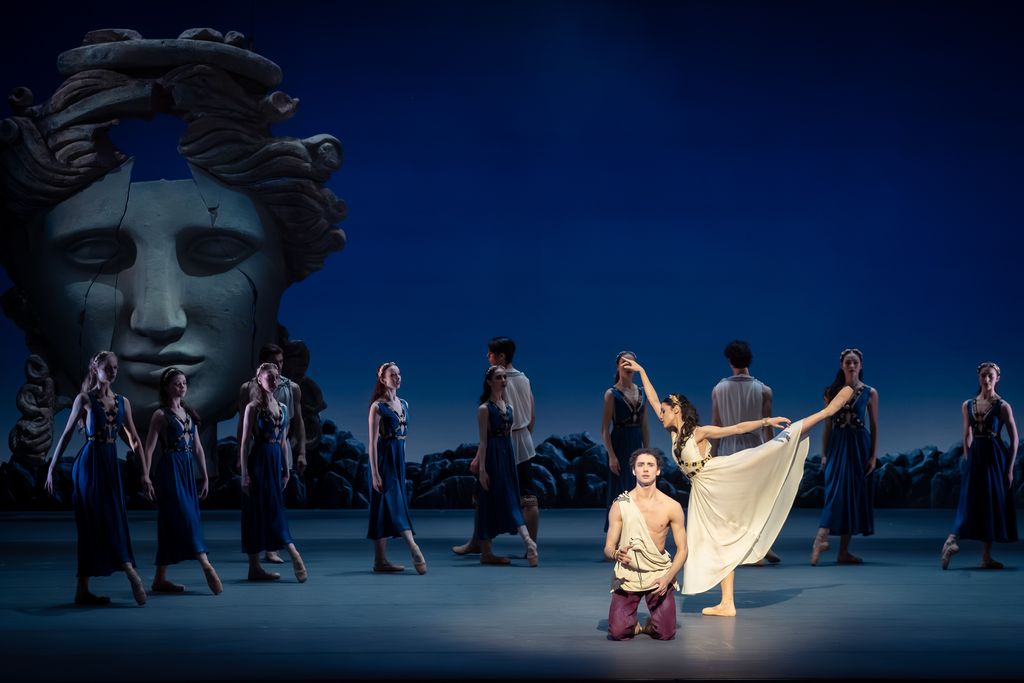
Chaereas’s ambivalence allows for divergent interpretations, and Alessandro Frola offers a markedly different yet equally persuasive reading. A leading figure of the Hamburg Ballet and a long-standing interpreter of John Neumeier, Frola had previously danced Dionysius when Kallirhoe entered the repertoire and here makes his debut as Chaereas. He emphasises the character’s guileless, almost pastoral quality—a kind of Sicilian Colas—bringing particular depth to moments of stillness and silence. His phrasing in adagio passages is eloquent, his classicism unfussy, and in Act II he unleashes a more expansive, almost animal physicality in the grand manège. The role allows him to deploy his impressive interpretive versatility while offering generous support to Sinthia Liz, the young Brazilian soloist making her long-delayed debut after injury. Less assured than Trenary, she brings a fragile immediacy to Callirhoe that proves touching.
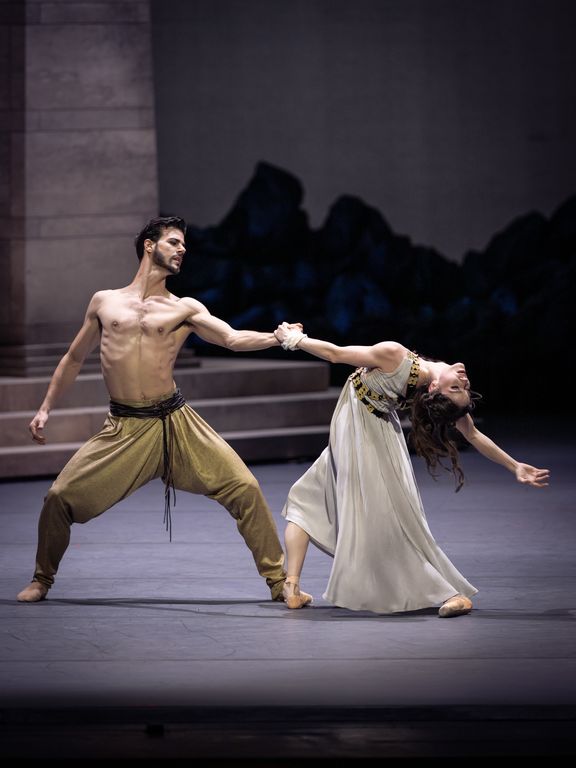
Choosing between the two casts is ultimately beside the point. Each probes different facets of Ratmansky’s richly faceted work, and both are supported by a strong constellation of secondary roles. Dionysius, Callirhoe’s imposed husband, is a study in tenderness shadowed by possessiveness. Davide Dato, in magnificent form, invests the role with aristocratic authority, dramatic intensity and a charisma that makes his duet with Callirhoe electric and his confrontation with Casalinho’s Chaereas genuinely gripping. Masayu Kimoto offers a more restrained presence. As Mithridates, it is Alessandro Cavallo—formerly of Béjart Ballet Lausanne—who most convincingly supplies the serpentine cunning needed to stand out in an Act II dominated by the central love triangle.
Around them, a gallery of secondary figures provides rhythmic drive : a lubriciously authoritarian King of Babylon, Chaereas’s loyal companions embodying rough camaraderie, a blazing and steadfast Polycharmos, Plangon the mediator, and a hieratic Queen of Babylon whose presence transcends betrayal. Across these roles, soloists, Principals and corps members alike find space for sharply etched characterisation.
Kallirhoe is not an easy ballet. It is dense, excessive and at times overwhelming—but also generous, theatrical and unapologetically ambitious. Ratmansky transforms an unwieldy ancient romance into a timeless meditation on love that endures beyond destructive rage, framed within a full-length work written in unapologetically academic vocabulary. In Vienna, the ballet finds a setting commensurate with its scale : a powerful orchestra, a revitalised company capable of absorbing its stylistic and emotional demands, and a roster of outstanding artists ready to project the Company’s renewed identity. One leaves this invigorating triumph eager to follow the next stages of the Wiener Staatsballett’s reinvention under Ferri—and no less curious to see what Ratmansky will unveil later this season in Hamburg with Alice in Wonderland. Much promising !