The impossible opera
It has often been written that Fidelio is a paradoxical work.
It is popular, celebrated as one of the classics of the international opera repertoire, and at the same time particularly difficult to perform successfully.
First of all, it is enough to note the difficulty Beethoven himself had in finding a definitive version between 1805 and 1814, with multiple regrets, magnificent musical pieces discarded, a libretto reworked several times… so much so that traditional performances of Fidelio today (and this is the case in Vienna) offer two overtures, that of the definitive Fidelio and that known as Leonore III, introduced by Gustav Mahler in the middle of the second act to mark the pause between the dramatic moments, the gradations, and even the difference in genre…
The work is part of a tradition that began in France at the end of the 18th century, known as ‘pièces à sauvetage’ (rescue pieces), the most emblematic example of which is Cherubini's Lodoïska, premiered in 1791, the biggest operatic success of the entire French Revolution with more than 200 performances, imitated (there are several variations, by Mayr, and even Rossini) and universally admired, by Beethoven of course, but also, more unexpectedly, by Brahms. The originality here by Beethoven comes from the fact that it is not a young girl who is being rescued, but a prisoner, and that the rescue is not carried out by a valiant knight or a young hero, but by a woman. The original libretto by Jean-Nicolas Bouilly, composed for Gaveaux's opéra-comique and premiered at the Théâtre Feydeau (where Lodoïska had been premiered), is in fact called Léonore ou l'amour conjugal.
Behind Fidelio, therefore, lie the foundations of a tried and tested form, repeated and extremely well known at the time, in both musical and literary works. And Beethoven's problem is quite simple : how to turn an extremely well-known, overused form, a fashionable cliché, into an original and unique work ?
If it were simply a matter of creating yet another comic opera based on the model of Lodoïska, which had become almost hackneyed some fifteen years earlier, it is obvious that Beethoven would not have been interested in it for his only opera.
So, based on the (indirect) model of Die Zauberflöte (The Magic Flute) another variation on the theme of rescue, Beethoven constructs a journey from darkness to light for the symbolism, from prison to freedom for the politics, from light-hearted Singspiel to epic musical theatre for the genre, and from Mozart to the grand “Beethovenian” form for the music.
Any undertaking that aims to stage and set Fidelio to music must deal with all this and untangle the web.
A vast programme.
The result ?
It is both simple and despairing. It is difficult to find a production of Fidelio that is fully satisfactory, even when created by the greatest directors. And indeed, the greatest have often been wary of tackling it or have come unstuck. Giorgio Strehler, for example, completely failed at the Châtelet in Paris, just as he had failed with Die Zauberflöte in Salzburg years earlier.
And yet the temptation is great to grapple with the great symbolism of humanism and freedom, to play with light and Les Lumières because the work lends itself to this kind of idealisation, and because it has considerable importance in Vienna, linked to the very history of the institution.
While Don Giovanni opened the Haus am Ring, the current venue, on 25 May 1869, Fidelio entered the house on 10 June. It was also with Fidelio that, on 15 October 1907, Gustav Mahler conducted for the last time at the Vienna State Opera after resigning.
More ironically or tragically, it was a performance of Fidelio conducted by Hans Knappertsbusch on 27 March 1938 that was given in honour of Hermann Göring, Minister President and Field Marshal, barely two weeks after the Anschluss…
On a more festive note, it was again Fidelio that celebrated the reopening of the Haus am Ring, rebuilt in 1955, conducted by Karl Böhm. Finally, as mentioned in the introduction, in 1970 Leonard Bernstein conducted the last production of Fidelio, directed by Otto Schenk, which lasted 55 years and ran for 253 performances until its final showing on 23 February 2025.
Finally, among the legendary conductors who have conducted Fidelio in Vienna, in addition to those mentioned above, are Gustav Mahler, Richard Strauss, Arturo Toscanini, Wilhelm Furtwängler, Herbert von Karajan, and others.
A new production of Fidelio, conducted by the former GMD of the house, Franz Welser-Möst, is therefore an unquestionable event, especially after 55 years of loyal service by the Schenk production, which many in Vienna regret to see disappear.
Nikolaus Habjan's production
Nikolaus Habjan, born in Graz in 1987, is virtually unknown out of Germany and Austria where he has spent most of his career. He is undoubtedly one of the most interesting figures in theatre direction, somewhat of an outsider in that he specialises in working with puppets, offering a vision of puppet theatre for adults, with often stimulating insights. He also worked with Franz Welser-Möst on a production of Zauberflöte in Cleveland in 2024, and it is no coincidence that he has been reunited with him for this new production in Vienna.
His project on Fidelio is a typical example of assertive intentions that are right, of obvious work on both the text and the contexts, on the characters, with in-depth reflection on the meaning of the work, and in particular on the figure of Leonore, but also on Rocco, who is more developed than in other productions and more psychologically profiled than a character who is ‘easier’ to portray, such as Pizarro…
But it is also a prime example of the gap between stated intentions and stage results. In other words, he too has fallen into the trap of the work, but while the interest of his work lies more on the margins than at the heart of the piece, his approach to staging also sheds light on the specific difficulties of the work.
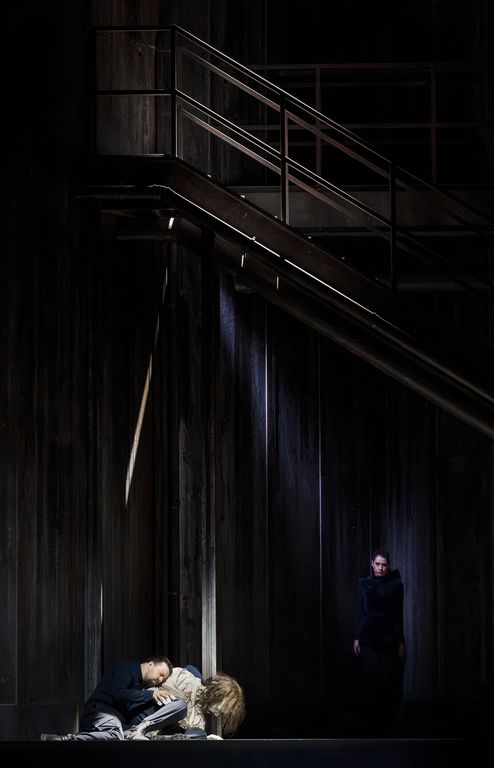
Julius Theodor Semmelmann's rather impressive and grey set is a wall that is occasionally pierced by scenes set in a niche : it is the overwhelming presence of the prison that is emphasised here, crushing all the characters who appear in it. This wall opens up a little to the light in the second act, but even – and this is somewhat paradoxical – Florestan's cell seems almost more airy than the wall in the first act, all of which is emphasised by Franz Tscheck's rather careful lighting.
This prison is contemporary, as emphasised by Denise Heschl's costumes, which are quite ‘timeless’ ".
But more than the atmosphere, Habjan works on the libretto and the characters. It is clear that the text of the Singspiel can appear a little outdated, even caricatural, in places, and he entrusted Paulus Hochgatterer with the task of re-reading the text, modernising and tightening it up, but also colouring the characters as he sees them : this is quite clear in the case of Jaquino, who is much less bland than in other productions. And on the whole, it is quite successful.
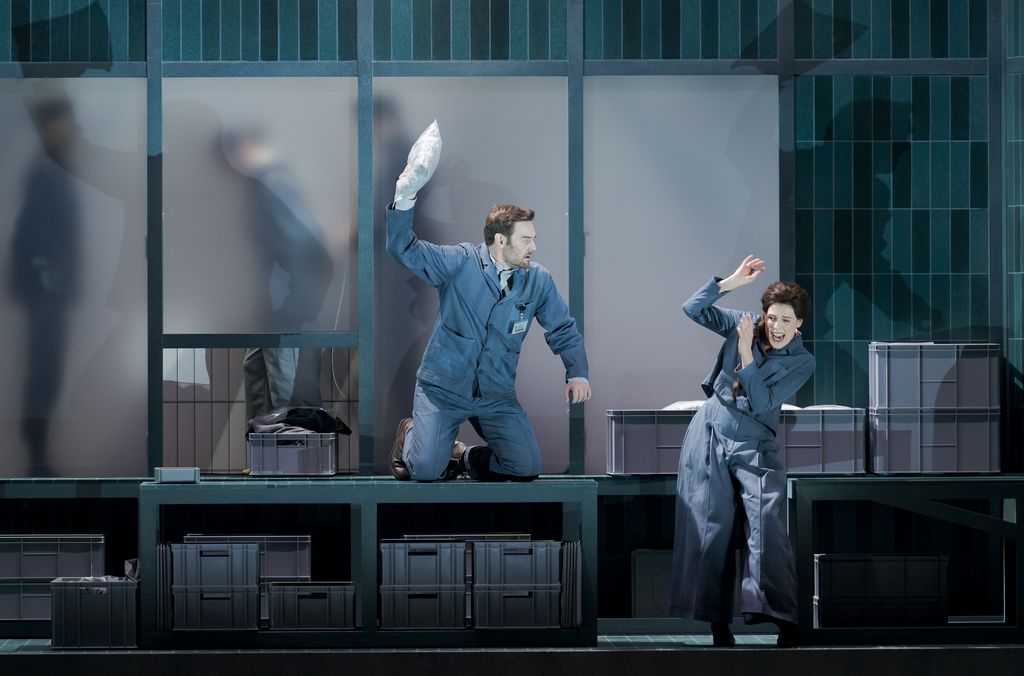
And it is all the more interesting because the work begins in medias res, more abruptly than usual, since the discussion between Jaquino and Marzelline does not take place in a domestic setting where Marzelline is ironing or hanging out the washing, for example, in a space separate from the prison world, but at the very heart of the penitentiary.
Habjan wanted to project this moment of discussion, which could be taken as a very scene of romantic spite à la Marivaux, into the more tense, more ‘realistic’ situation of the continuous arrival of prisoners, who are stripped of their ‘civilian’ appearance and given their status as prisoners, behind a glass window where we can guess at the ritual of undressing (which in this case is also symbolic : you are stripped of your ordinary humanity and given that of a prisoner).
How can we not think of entering the camps, with the same type of procedure ?
Marzelline collects the civilian clothes in a tray, hands the guards the prisoner's uniform wrapped in plastic (everything is clean…), and sends the tray with the clothes on a conveyor belt to an unknown destination.
On the one hand, we think of the camps, but on the other, we also think of airport security searches, where whatever you put in the tray goes through a tunnel for X‑ray analysis… Here again, images of our history or our civilisation today, of our mundane travel habits, overlap, saying a lot about the ‘enlightenment of humanism’ today. In this respect, the scene is well drawn, especially as the prisoners keep filing past… There is a lot of imprisonment in this prison.
In such a context, it is impossible to imagine a scene of romantic spite such as we see so often in comedy scenes, and Habjan immediately makes it clear that the Jaquino/Marzelline couple is a thing of the past. Jaquino is indeed much more aggressive and Marzelline more definitive. He has just realised that he has lost the game, and she has realised that Jaquino was not her ideal partner. On the one hand, there is despair, and on the other, the wild hope of another life, all expressed amidst the prisoners who parade by… A dark omen… Jaquino has never been an interesting character, and the more astute Marzelline understands this, regardless of the staging, but here he has something negative about him, something repulsive : we hear in him (and with the changes made to the libretto) a future coward under the orders of Rocco at best or Pizarro at worst, a small and petty soul to which Marzelline does not aspire.
Marzelline's profile is different.
In some misguided productions, at the end, amid general rejoicing, the couple Jaquino/Marzelline are reunited, lovers as before, as in Auber's comic operas. But the reality is different.
Marzelline confronts Fidelio and Jaquino and measures the gap between them. She understands that she cannot live a lifetime with Jaquino. Regardless of Fidelio's nature (Leonore in disguise), Marzelline has perceived something else in Fidelio, something higher, which nourishes her. And this feeling is shared by Rocco, the father, who is no angel either. Fidelio's presence in the small family brings a calming force, a humanity that has penetrated the prison and its universe, which the characters cannot define but can feel.
This is also the strength of Beethoven's libretto, which goes beyond the anecdotal and shows that the feeling of humanity determines contagious attitudes and behaviours around it. Only Jaquino is not sensitive to this, and so he excludes himself from the whole plot, quickly becoming useless.
But in the end, Marzelline, touched by Fidelio, will ultimately reach the depths of despair : she loves (or loved) the right person, adorned with the cardinal virtues of the Enlightenment, but he is not the ‘right’ person, since everything Leonore-Fidelio has accomplished has been for another purpose, and Leonore-Fidelio had to lie to Rocco and to her in order to achieve her truth and her goal. In Fidelio, there are two real losers : Pizarro on the one hand, who deserves it, and Marzelline on the other, who loses simply because she was able to distinguish good from evil, the great from the petty. She loses in the name of Enlightenment and justice.
She loses because she saw things clearly, and she loses everything without remedy. Habjan clearly understood the ‘tragedy’ of the character and her situation : in fact, he himself says that one of the reasons for making Fidelio a puppet (the Fidelio seen by others) is to allow Leonore (the singer) to express her true feelings, particularly when she sympathises with Marzelline's future disillusionment and thus to play at being/ appearance through this double game.
Habjan makes Rocco the central character of the work, even though he is often considered a weak link, obedient and submissive, essentially driven by greed. Rocco is excessively attracted to money, and only money. He robs the prisoners, constantly seeking to gain something, and as a result, the set design makes the interior of his flat not a simple interior as we often see, but rather a bourgeois kind of opulent island in a prison universe.
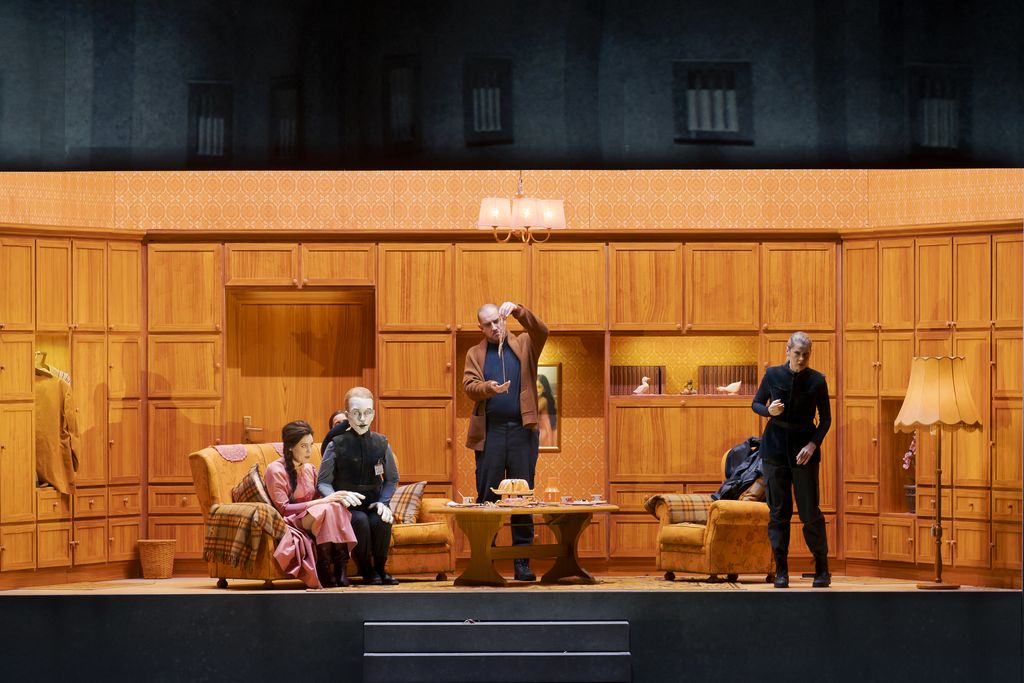
It is, moreover, a rather successful splash of ochre-gold colour in a rather uniformly black and grey universe.
For Nikolaus Habjan, Rocco is the only one who is transformed by the situation. He is sensitive to Fidelio and willingly gives him to Marzelline, leaving Jaquino to his disappointment.
He is so sensitive to it that in the second act, instead of siding with Pizarro, he takes up the cause of Fidelio-Leonore and switches to the side of Light. Similarly, at the end, he interrupts the Minister to praise Leonore, who has freed Florestan : in a way, he is touched by the Enlightenment grace that transforms hearts, and he responds, perhaps even more than Leonore (who aims first and foremost to free her husband), to Beethoven's idealistic message. Tareq Nazmi, playing a Rocco who is both introverted and more reserved, but who explodes in the second act, finds one of his greatest roles in this unusual profile of a more ‘respectable’ Rocco.
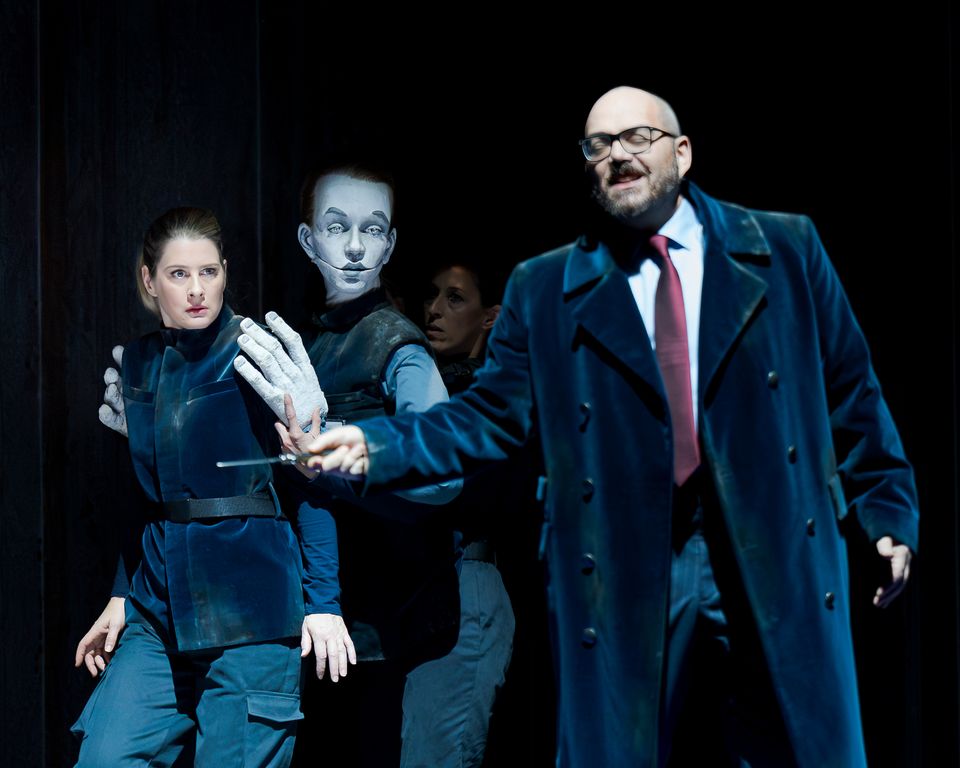
Habjan also makes Pizarro a slightly more complex figure than the usual diabolical Pizarro. With Christopher Maltman, a singer well versed in complex and tortured characters, he constructs a Pizarro halfway between an authoritative civil servant and a politician, in line with the cohorts of politicians without greatness or courage who today fill our assemblies, our election campaigns and TikTok.
With his overcoat, suit and tie, he has the desired uniform : it is the uniform that makes him appear respectable, the uniform of appearance : the clean-cut delinquent.
But he is just as cowardly as the others and must protect himself.
His situation is not that of an autocrat or a dictator : he has the intermediate status of a depositary of authority who has abused it slightly to get rid of troublemakers (Florestan). And the Minister's visit risks exposing the truth : the risk must therefore be quickly eliminated, and with it Florestan. These autocratic petty kings have proliferated in empires ; they are figures like Paolo in Simon Boccanegra, but not like Iago or Scarpia. They are not evil rulers, they are evil functionaries, banal in the manner of Eichmann, as Hannah Arendt would say.
Thus, as Habjan sees it, he benefits from a psychology that he does not always have elsewhere, because he is afraid : he is afraid of what he is hiding, he is afraid of his prisoner and he is afraid of his superiors. He fears his prisoner, in his very existence, because he is a threat, even at the bottom of this dungeon hidden from everyone. On the other hand, he does not fear the others, not the group singing O welche Lust, in freier Luft / Den Atem leicht zu heben !, whom Habjan does not depict as liberated, gazing at the light, but as a human wall enclosed behind bars, in a particularly powerful and beautiful image.
Because this group is a mass of prisoners in broad daylight. They can ‘freely’ sing about the light, it doesn't matter, they are official, and therefore dominated.
The one who is hidden is not a registered prisoner, he is a stowaway in the dungeons, he is living proof of arbitrariness. He must therefore be put to death.
Pizarro is therefore forced by circumstances to kill him, in an equally clandestine, cowardly and even petty manner. The execution takes place in broad daylight, while the murder, the “little murder”, always remains in the shadows. Pizarro is here a small fry, a low-ranking criminal.
This is both paradoxical and sad because it is on the two main characters that not only the mistakes and blunders are concentrated, but also the collapse of the entire construction.
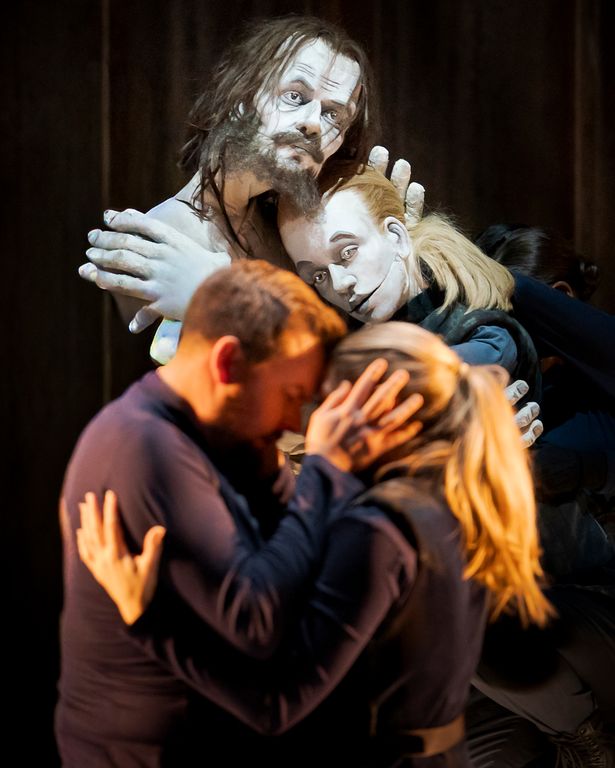
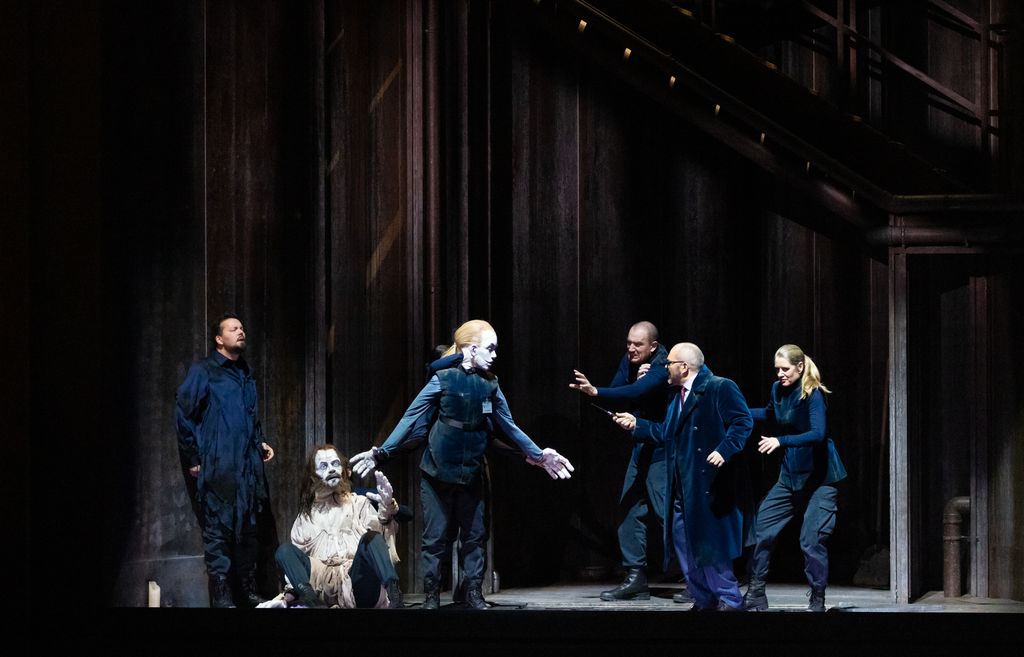
The in-depth look at the characters and their relationships, and the rather sharp eye on the libretto, were more or less convincing up to this point, but as soon as Fidelio appears on stage, with four people, a puppet operated by two puppeteers and the singer, something shifts and creates unease. Not that the puppet is poorly made – quite the contrary, Nikolaus Habjan is a master of the genre, and puppet maker Bruno Belil has succeeded in creating impressive figures – but what is disturbing is the ‘mechanical’ aspect. The puppet is there to show that there are two sides to the character of Leonore : two characters : the one that others see, namely Fidelio, and the one she really is, namely Leonore, and that what she sings is who she is. Fidelio does not exist, he is an appearance, but the (only) puppet that the other characters are supposed to see is transformed for the audience into four people who move heavily, including the singer, who does not always seem to know what she is supposed to do or even what she is doing there.
At the same time, the desired effect is lost.
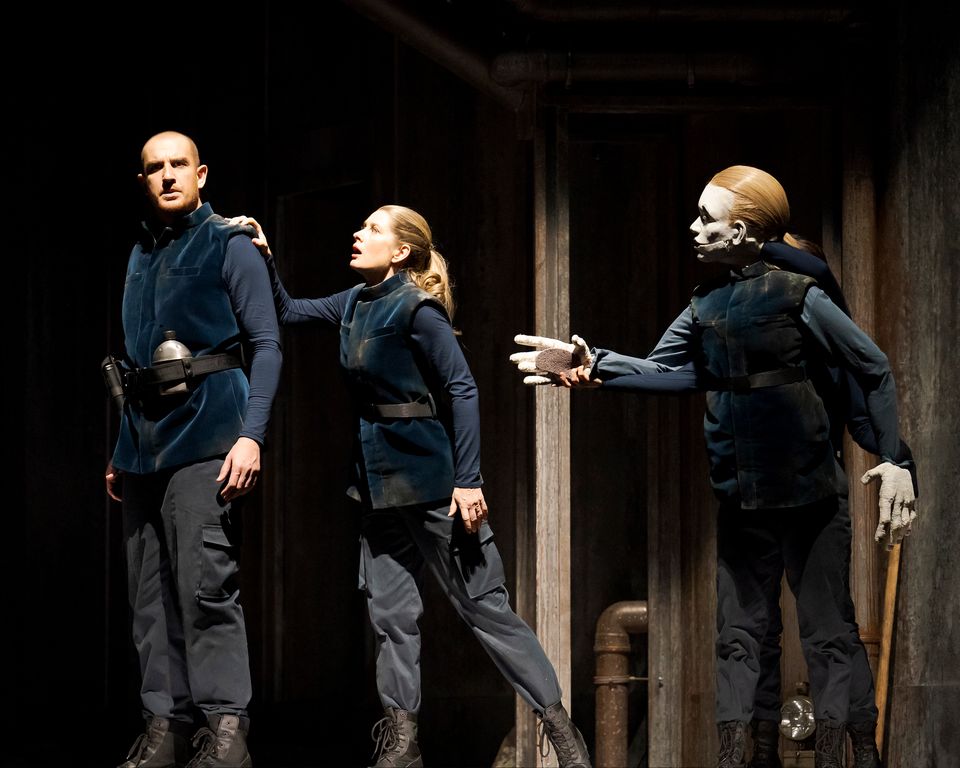
Of course, Habjan wanted to skilfully superimpose the effects, show the theatrical mechanics of the puppet, try to show the illusion, but also superimpose the musical effects, those of Beethoven's music. Overall, perception, feeling and vibration should be woven together, but what we perceive has the effect of destroying the vibration. It is heavy and, ultimately, it doesn't matter whether it is plausible or implausible, because that is not the problem. The problem is that we end up no longer seeing the point of it.
The problem is that the main character moves away from us. Where is he ? Who is he ? Is it this mechanical figure or this shadow that moves and sings behind, to the right and to the left ? Where exactly are we ? All emotion disappears where the director thought he was singling it out and isolating it.
In the second act, the same cause produces the same effect with Florestan singing his impossible aria (‘Gott’) on one side, and on the other, a collapsed puppet with a vaguely beastly appearance (a forgotten Jochanaan…) in a dark corner.
This means that the whole scene with three characters – Leonore, Rocco and Florestan, then four with Pizarro – becomes a somewhat cluttered scene with eight characters and two puppets… A lot for a cellar… The idea of doubling, of characters whose outward appearance does not correspond to their real emotions and true humanity, was not without coherence, but it is undoubtedly a failure because the right technical solution was not found and the effectiveness of the stage result is questionable, to say the least.
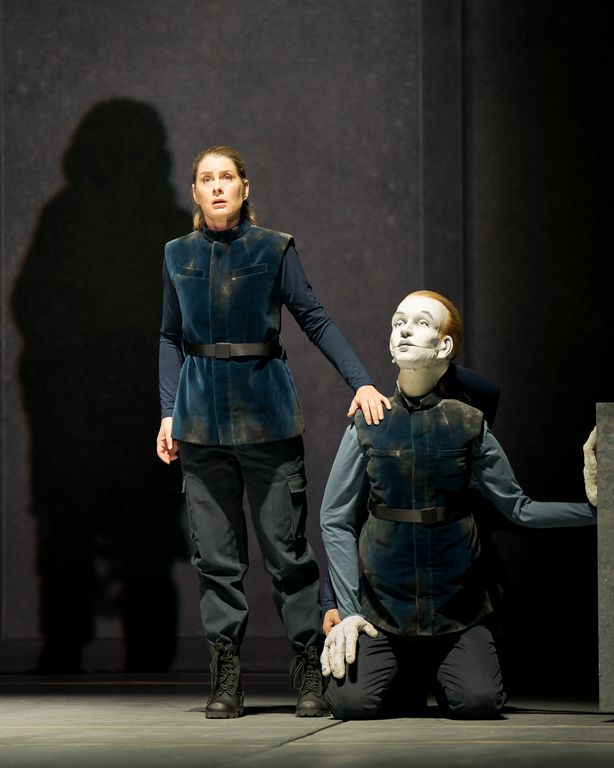
This puppet effect, which could have reinforced the dramatic effects, destroys them and ends up being distracting, annoying and consigning the production to the shelf of failed productions of Fidelio, when it does not deserve to be there.
Habjan's idea is quite clear : there are men like Rocco, who in Beethoven's idealised world are transformed by contact with a ray of light called Fidelio-Leonore, and there are those who remain petty and mediocre, like Jaquino and Pizarro. There are those who are left behind and the unwitting victims, Marzelline. And the two heroes are emblems, essentially Leonore more than Florestan.
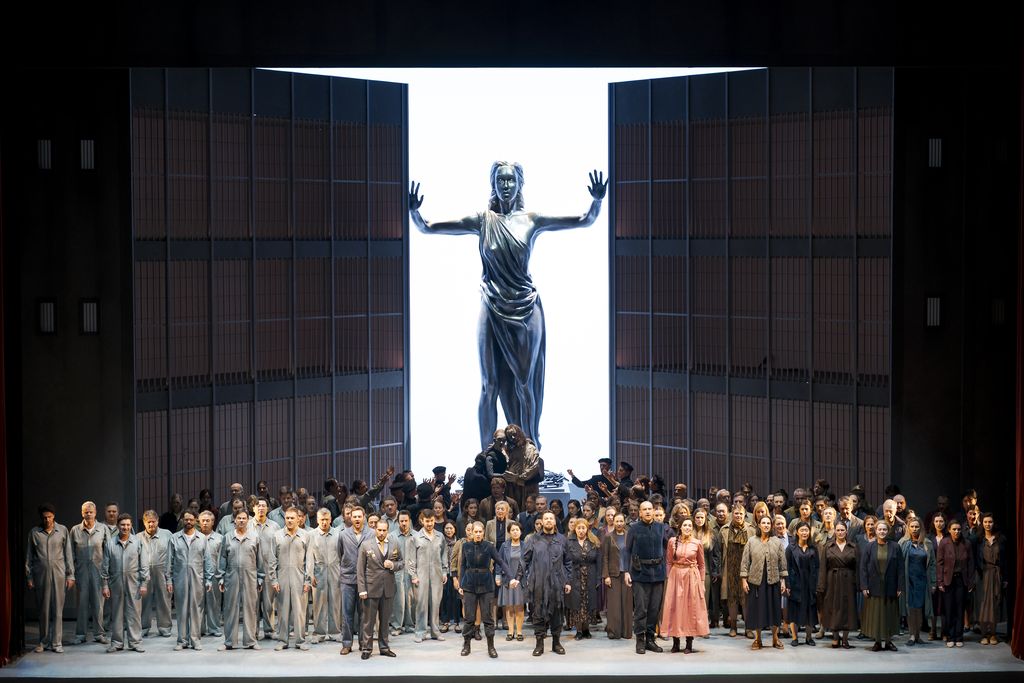
Florestan is not an ‘actor’ in this affair, he is the victim who is saved. It is Leonore who is the emblem, the symbol, more than just a human being. She is distanced, first as a puppet, then at the end, when the light comes on, the stage opens onto a giant statue of Leonore, an image of "marital love “. She is an image that inspires, stimulates and transforms ; she is a benevolent abstraction. This is how we see her in this production, distant from us, like a figure of adoration : no longer quite human. Perhaps this is also why, in this final scene, we continue (inexplicably?) to see the puppets…
Ultimately, the only real puppet is the minister who arrives at the end to make a pointless political speech, followed in this production by a disorderly procession of journalists, suggesting that he is there for the ‘public relations’ and restoring or reminding us of the nature of power and who exercises it. He too is a deus ex machina figure who restores freedom to the people and order to society. But this is just a façade… words, not action…
In other productions, such as that of filmmaker Chris Kraus some time ago with Abbado in Baden-Baden, Ferrara, Madrid and elsewhere, the minister was merely the one who came to impose a new dictatorship replacing that of Pizarro, and the joyful finale only accompanied new gallows or new guillotines. The minister can therefore be a Deus ex machina, or a Diabolus ex machina, depending on one's vision and faith in humanity.
In any case, in my opinion, he really deserved to be a puppet because he is only what we see or think we see of power, or what we attribute to him.
Fidelio therefore still has things to say and to explore, and it is regrettable that Habjan's very real reflection has come up against a technical aporia… or a genuine mechanical error. And this keystone, far from holding the whole thing together, actually contributes to its collapse.
This is one of the reasons, it seems to me, why this production, which is destined to be revived given the nature of the title and its importance in Vienna, will not last five decades or more. If the two current protagonists are struggling to extricate themselves from the stage situation despite lengthy rehearsals with the director and creator of these puppets, imagine the numerous revivals with personalities who will inevitably be very different. The production is therefore far from having found its cruising speed.
The voices
We have already addressed the issue of the vocal difficulty of the work, which doubles that of its dramaturgical difficulty. The two main roles are among the most difficult in the repertoire because they are unclassifiable.
To simplify, either you consider Fidelio to be a work still very much influenced by the 18th century with an ad hoc orchestra, in which case you can conceive of the two leading voices as heirs to Vitellia and Tito, or the tenor as a copy of Floreski from Cherubini's Lodoiska (and the similarity between Floreski and Florestan already tells us a lot) Or you can look at Fidelio through the lens of the 19th century and Wagner, with particularly dramatic voices, but nevertheless endowed with a flexibility that Wagnerian voices do not always have.
There is no middle ground ; you only have to look at the casts that have been recorded to see which way the balance tips…
For the other roles, it is much easier and, in a way, the cast brings together a wide range of possibilities.
But from the outset, we were bothered by a sound that did not carry across the stage, by voices that did not break through the fourth wall, as if the set and all the stage apparatus prevented the sound from coming through, from being heard, and kept it muffled.
The opening of the set during the second act allowed the voices to be exposed in a different way, but the entire first act was, or at least seemed, particularly hampered by sound that did not carry, with dialogue that was difficult to hear and muffled voices, to the detriment of Jaquino in particular and Marzelline even more so.
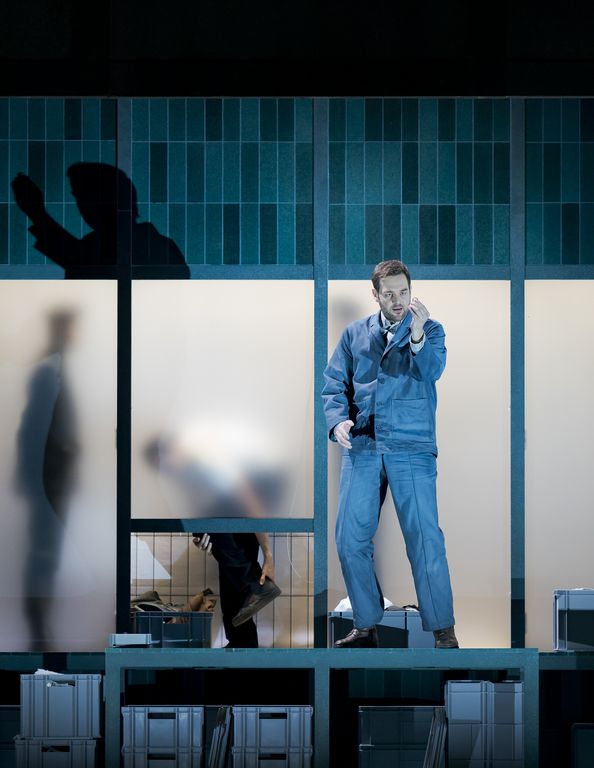
Daniel Jenz as Jaquino succeeds in giving the character a rather different colour than usual, and in this he shows that the staging has succeeded in ‘evolving’ the image we have of him.
Admittedly, the difficulties mentioned above (the set?) mean that his voice is not always clearly defined, but nevertheless we are far from a characterless ‘tenorino’ Jaquino. On the contrary, the dialogue is assertive and the voice confident, clear and quite present, and the singer brings out the opportunistic side of the character, who has no backbone other than the law of the strongest. He is a new profile, unquestionably worthy of interest.
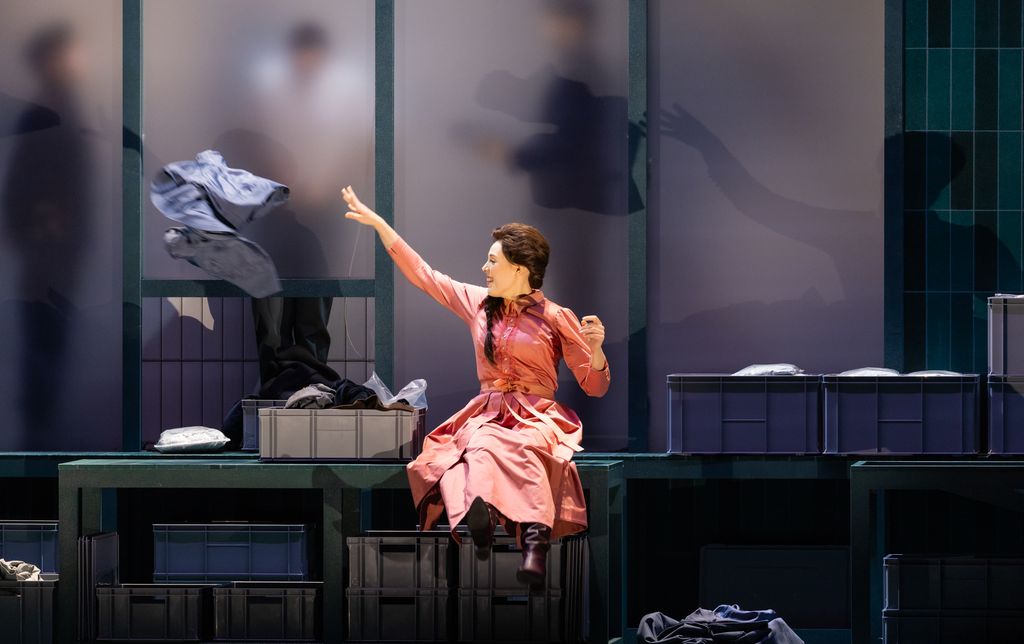
Kathrin Zukowski (Marzelline), a member of the Studio, replaces Florina Ilie with great grit, freshness and elegance, even though she too is handicapped by the difficult sound diffusion. There are moments when she cannot be heard, or barely, and this is not due to vocal inadequacy, as it affects the entire cast. She nevertheless manages to convey the character's determination, which makes it clear that she has nothing to gain from Jaquino : the freshness she displays signifies sincerity, not naivety. Worth hearing again for the intelligence of the singing and the elegance.
Simonas Strazdas, also a member of the Studio, as Don Fernando displays a well-projected, clear voice with beautiful phrasing and particularly effective projection. His is undoubtedly an interesting voice with a striking velvety timbre. One to watch.
Christopher Maltman sings Don Pizarro, always very engaged in the staging, with a powerful voice without ever falling into the caricature of the villain and the cheap villain. He therefore embodies a more ‘ordinary’ Pizarro, giving the character a different weight and a more human valence, making him surprisingly more interesting than usual. It is the mark of great performers that they colour the roles they play in a unique way. And Maltman once again demonstrates what intelligent singing and acting mean. Impressive.
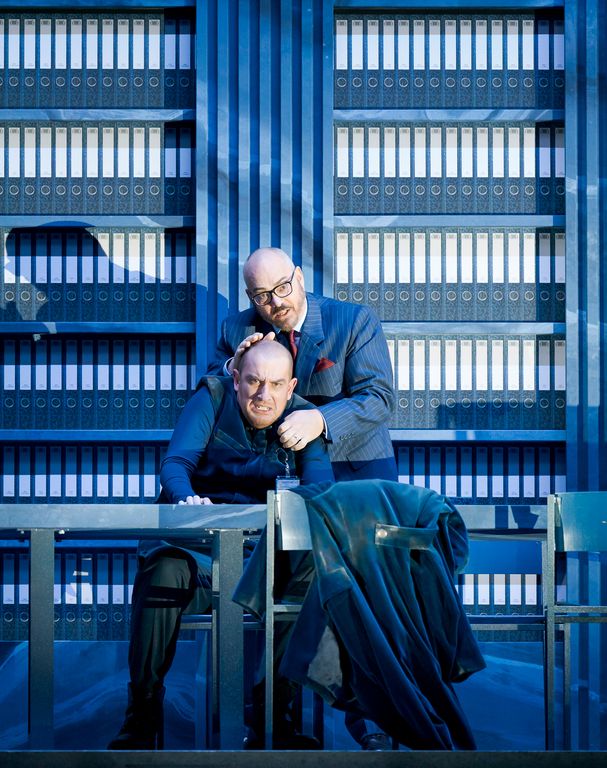
Tareq Nazmi is also an unusual Rocco, more distant, more introverted, far from the good-natured, obedient and submissive character, and at the same time always astonishingly human. His voice is solid, as always, without showing off, but with real intensity and a certain eloquence, and he transforms himself vigorously in the second act, revealing the different facets of his personality and his way of colouring his singing. An original Rocco, particularly worthy of interest.
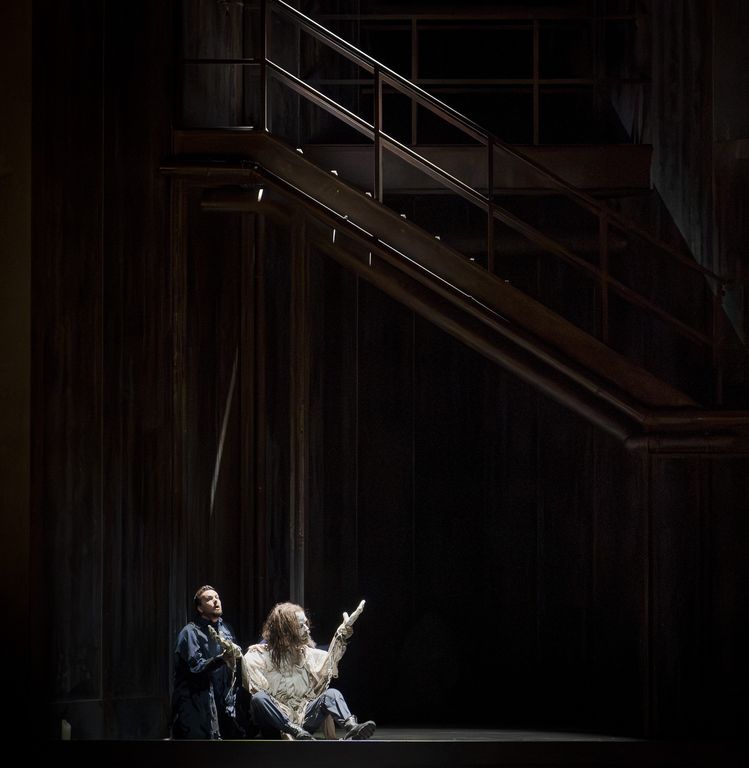
Puppet or not, David Butt Philip's Florestan will not be remembered. In fact, will any role performed by this tenor ever be remembered ? His voice is clear, his timbre pleasant, his high notes sustained and quite powerful. He sings very correctly… But beyond that ? An incarnation ? A universe ? An emotion ? A dreary plain, weighed down by the weight of the puppet…
Florestan needs a performer who knows how to weigh every word, every breath, who makes the suffering sweat in his first aria, who knows how to explode in the duet that follows with Leonore, who vibrates and makes others vibrate. The performance is honest, but it is already forgotten. There is no need to draw painful comparisons.
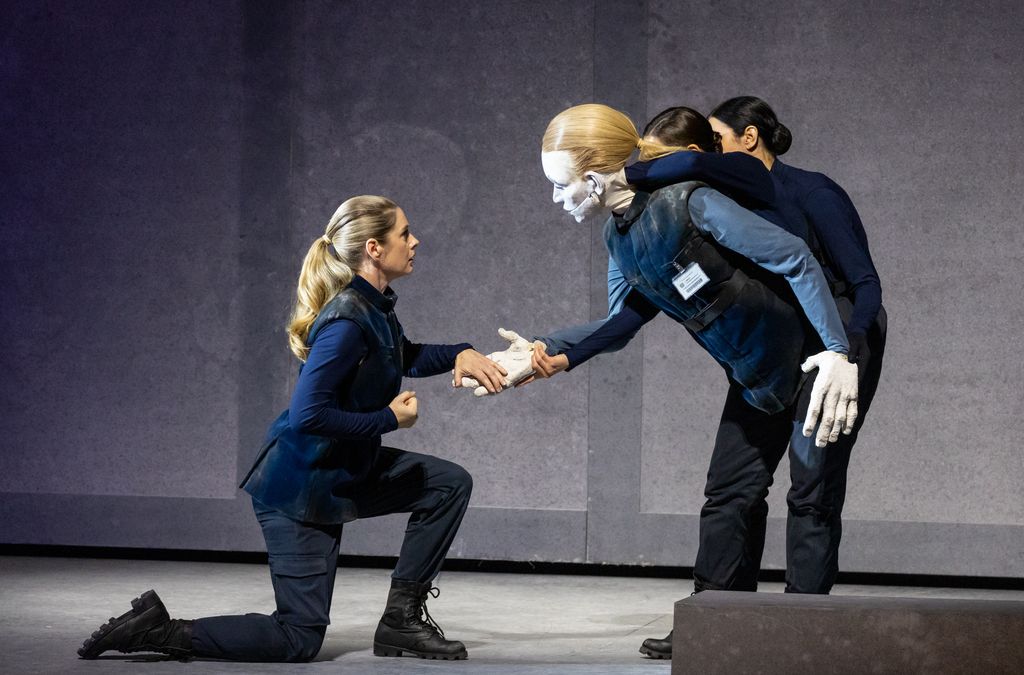
The case of Malin Byström as Leonore is different. The notes are there, the energy is there, but so is the difficulty of freeing herself from the fatal puppet, which may also explain a certain lack of embodiment or emotion. There are Leonores who grab you and carry you away with less vocal volume, even less energy, but more colour, more nuance. Here, the singing is powerful but uniform and leaves one cold overall. The interpretation remains within the limits of a convention that does not excite interest. Here is a singer who has the notes, the power and even a presence, but fails to convey anything other than a very dignified performance, which works if you like, but never provokes the slightest thrill. A raging ice floe.
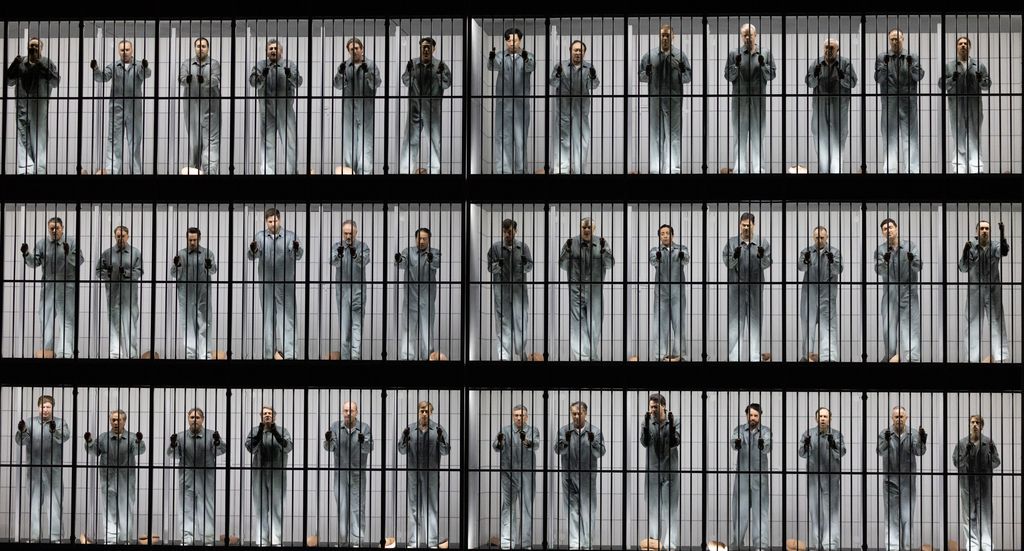
Prepared by Thomas Lang, the Vienna State Opera Chorus is up to the task, with tenor Daniel Lökos and bass Panajotis Pratsos in the front row, Erster and Zweiter Gefangener in the chorus of the first act, but it really explodes in the final part, offering an impressive performance, reminiscent of the flights of fancy in the Ninth, and this power creates real emotion and the feeling of experiencing an exceptional moment.
Musical direction
We noted the orchestra's commitment in Elektra. We can similarly highlight this in Fidelio, where, after a few days, what remains is essentially Franz Welser-Möst's approach and the way he makes his Beethoven sound.
From the overture onwards, we note the energy, the sonic roundness, the different layers of the score, but it is in the muted accompaniment of the quartet Mir ist so wunderbar, which then develops, and in the rather dramatic way in which he approaches the Singspiel, which we have already heard performed in a ‘lighter’ manner than this interpretation, that the overall very classical construction takes shape.
It is also the orchestra that unleashes the passions and ovations after a performance that is once again ‘traditional’ but incredible in its dynamism and energy in the Leonore III overture, placed where Mahler had intended, creating a silence and concentration in the hall that precedes the storms of applause. And this energy, as if stored in a box, then explodes in the orchestra throughout the final scene, transcending a performance that without these orchestral flights of fancy would have remained rather frustrating.
Franz Welser-Möst offers a classic vision of a ‘Beethovenian’ Beethoven, breathtaking in its grandeur and pathos, while at the same time triggering what was missing from the evening : an indescribable emotion that makes you say to yourself, ‘This is Vienna, without a doubt, and what incredible luck to be here.’ The last thirty minutes alone made the trip worthwhile…